Special guidelines for overviews and meta-analyses.
This is a first draft of Chapter 5 of my book, "Statistical Evidence."
Introduction
Meta-analysis is the quantitative pooling of data from two or
more studies. When you are examining the results of a meta-analysis, you
should ask the following questions:
Were apples combined with oranges? Heterogeneity among
studies may make any pooled estimate meaningless.
Were all of the apples rotten? The quality of a
meta-analysis cannot be any better than the quality of the studies it is
summarizing.
Were some apples left on the tree? An incomplete search
of the literature can bias the findings of a meta-analysis.
Did the pile of apples amount to more than just a hill of
beans? Make sure that the meta-analysis quantifies the size of the effect
in units that you can understand.
Declining sperm counts
In 1992, the British Medical Journal published a controversial
meta-analysis. This study (BMJ
1992: 305(6854); 609-13) reviewed 61 papers published from 1938 and 1991
and showed that there was a significant decrease in sperm count and in
seminal volume over this period of time. For example, a linear regression
model on the pooled data provided an estimated average count of 113 million
per ml in 1940 and 66 million per ml in 1990.
Several researchers (Fertil
Steril 1996: 65(5); 1044-6 and
Fertil Steril 1995: 63(4); 887-93) noted heterogeneity in this
meta-analysis, a mixing of apples and oranges. Studies before 1970 were
dominated by studies in the United States and particularly studies in New
York. Studies after 1970 included many other locations including third world
countries. Thus the early studies were United States apples. The later
studies were international oranges. There was also substantial variation in
collection methods, especially in the extent to which the subjects adhered to
a minimum abstinence period.
The original meta-analysis and the criticisms of it highlight both the
greatest weakness and the greatest strength of meta-analysis.
Meta-analysis is the quantitative pooling of data from studies with
sometimes small and sometimes large disparities. Think of it as a
multi-center trial where each center gets to use its own protocol and where
some of the centers are left out.
On the other hand, a meta-analysis lays all the cards on the table. Sitting
out in the open are all the methods for selecting studies, abstracting
information, and combining the findings. Meta-analysis allows objective
criticism of these overt methods and even allows replication of the research.
Contrast this to an invited editorial or commentary that provides a
subjective summary of a research area. Even when the subjective summary is
done well, you cannot effectively replicate the findings. Since a subjective
review is a black box, the only way, it seems, to repudiate a subjective
summary is to attack the messenger.
Meta-analysis is used in a variety of different areas. Vine et al (Fertil
Steril 1994: 61(1); 35-43) used meta-analysis studied the relationship
between smoking and sperm concentration. Oehninger et al (Hum
Reprod Update 2000: 6(2); 160-8) assessed the utility of sperm function
assays in predicting successful outcomes in IVF. Goldberg et al (Fertil
Steril 1999: 72(5); 792-5) compared intrauterine and intracervical
insemination with frozen donor sperm. Evers et al (Cochrane
2001: 1CD000479) reviewed the effectiveness of varicocelectomy in
subfertile men.
Were apples combined with oranges?
Meta-analyses should not have too broad an inclusion criteria.
Including too many studies can lead to problems with "apples-to-oranges"
comparisons. For example, when you are studying the effect of cholesterol
lowering drugs, it makes no sense to combine a study of patients with recent
heart attacks with another study of patients with high cholesterol but no
previous heart attacks.
There is a lot of variability in how research is conducted.
Even in carefully controlled randomized control trials, researchers have
tremendous discretion (Am
J Med 1987: 82(3); 498-510.). Sometimes this discretion creates
heterogeneity among studies, making it difficult to combine the studies.
Heterogeneity in the composition of the treatment and
control groups
-
Researchers can differ in the inclusion and exclusion
criteria.
-
Even if these criteria do not differ, there may still be
differences in the baseline levels of health in the patients, due to
geographical differences in the patient population.
-
The controls could be selected independently, or they could
be matched to the treatment group subjects.
-
The control subjects could be given no treatment, a placebo,
or a standard treatment.
-
The treatment could differ, such as differences in dose or
timing of a drug.
Heterogeneity in the design of the study
Heterogeneity in the management of the patients and in
the outcome
-
How comorbid conditions are treated.
-
How complications are handled.
-
How much discretion the patient's physician has in
controlling patient care.
The outcome measure itself could differ. For example, Abramson
(Public
Health Rev 1990: 18(1); 1-47) discusses a meta-analysis of hypertension
treatment in the elderly. Some of the studies examined cardiovascular deaths
and others examined cardiovascular events. Other studies examined
cerebrovascular deaths, cerebrovascular events, cardiac deaths, coronary
heart disease deaths, and/or total deaths.
Examples of heterogeneity
In a meta-analysis (BMJ
2002; 324(7340): 757) looking at antiretroviral combination therapy, a
plot of duration of
trial versus the log odds ratio showed that shorter duration trials of
zidovudine had substantial evidence of effect (odds ratios much smaller than
1) but that the largest duration studies had little or no evidence of effect
(odds ratios very close to 1).
In a meta-analysis (BMJ
1998: 317(7166); 1105-1110) looking at dust mite control measures to help
asthmatic patients, the studies exhibited heterogeneity across several
factors. Six studies examined chemical interventions, thirteen examined
physical interventions, and four examined a combination approach. Nine of
these trials were crossovers, and in the remaining fourteen, there was a
parallel control group. Seven studies had no blinding, three studies had
partial blinding, and the remaining thirteen studies used a double blind. In
nine studies the average age of the patients was only 9 or 10 years, but nine
other studies had an average age of 30 or more. Eleven studies lasted
eight weeks or less and five studies lasted a full year. You can find a
table summarizing
these studies on the web.
How to handle heterogeneity
Some level of heterogeneity is acceptable. After all, the
purpose of research is to generalize results to large groups of patients.
Furthermore, demonstrating that a treatment shows consistent results across a
variety of conditions strengthens our confidence in that treatment.
Nevertheless, you should be aware of the problems that
excessive heterogeneity can cause. Mixing apples and oranges may not be so
bad; you get a fruit salad this way. But when heterogeneity becomes too
large, you might end up combining not apples and oranges but apples and
onions.
Subgroup analysis
When there is substantial heterogeneity, you can look and
compare subgroups of the studies. In a meta-analysis (BMJ.
2000; 321(7273): 1371-6) studying atypical antipsychotics, the dose of
the comparison drug (haloperidol or an equivalent) varied substantially.
Among those studies where the dose of haloperidol was greater than 12 mg/day,
atypical antipsychotics showed advantages in efficacy or tolerability. When
the dose was less than or equal to 12 mg/day, the atypical antipsychotics
showed no advantages in these areas.
Meta-regression
You can try to adjust for heterogeneity in a meta-analysis.
This would work very similarly to the adjustment for covariates in a
regression model. For example, Derry et al (BMJ
2000: 321(7270); 1183-7) used meta-analysis to see if long term aspirin
therapy was associated with problems with gastrointestinal hemorrhage. They
identified 24 studies that looked at aspirin as a preventive measure against
heart attacks. In each of these studies, the rate of gastrointestinal
hemorrhages were recorded for both the aspirin group and the placebo or no
treatment group. There was substantial heterogeneity in the dosage of aspirin
used in the studies, however, with some studies giving as little as 50 mg/day
and some as much as 1500 mg/day.
This was actually good news in a way, because the researchers
wanted to see if the risk of gastrointestinal hemorrhage was dependent on the
dose of aspirin. A
plot of the dose versus the risk showed that there was indeed an
increased risk but that this risk seemed to be unrelated to the dosage.
Inclusion of very old studies
Dear Professor Mean: When conducting a systematic review how far
back should you look? Do you set your exclusion criteria judging on the
amount of literature available, or do you limit your search to, say the last
10 years? Hunting Heather
That depends a lot on the topic, don't you think? Anything in the field of
neonatology would have to have a very narrow time window because the field
has changed so much so rapidly.
Other areas where the practice of medicine has been much more stable could
have wider time windows. I've seen several reviews that have covered half a
century of studies.
If you do select a wide time window be sure to see if your results are
similar if you restrict yourself to just the most recent studies.
Ask yourself if there was a sudden change in technology that makes any
comparisons before and after that technology an apples-to-oranges comparison.
So, for example, a meta-analysis involving AIDS patients should restrict
itself to the years following the use of AZT.
Also, ask yourself if researchers in your area tend to discount any
research that is more than X years old. If so, then your meta-analysis would
lose credibility among those researchers if it included studies older than X.
Sensitivity analysis
A good approach to heterogeneity is to include a wide range of
studies, but then examine the sensitivity of the results by looking at more
narrowly drawn subsets of the studies.
The authors can also weight studies by a quality factor and
give greater emphasis to randomized studies, which are less likely to have
bias. Second, the authors can perform sensitivity analyses. Would the results
change if we changed the entry criteria?
In general, heterogeneity increases uncertainty, but this
uncertainty cannot be reflected in the width of the confidence limits in the
meta-analysis results. When there is heterogeneity, the most information may
reside not in a single estimate of how effective the treatment is, but in a
careful examination of the variation in the treatment under different
conditions.
Were
all of the apples rotten?
The quality of a meta-analysis is constrained by the quality of articles
that are used in a meta-analysis. Meta-analysis cannot correct or compensate
for methodologically flawed studies. In fact, meta-analysis may reinforce or
amplify the flaws of the original studies.
Observational studies in a meta-analysis
The use of meta-analysis on observational studies is very controversial.
Some experts have argued that the biases inherent in observational studies
make a meta-analysis an exercise in mega-silliness. But even those experts
who do not take such an extreme viewpoint warn that the current statistical
methods for summarizing the results of observational studies may grossly
understate the amount of uncertainty in the final result (BMJ
1998: 316(7125); 140-4).
Sensitivity analysis may be a useful way of highlighting the uncertainties
in a meta-analysis of observational studies. Restricting the meta-analysis to
selective subgroups of the data can yield insight into the size and direction
of biases in observational studies. For example, the researchers could
contrast case-control designs with cohort designs, with the latter expected
to show less bias, in general. Or the researchers could compare retrospective
studies to prospective studies, where again, the latter is expected to show
less bias in general. Another possibility for comparison involve comparing
studies by the amount to which measurement error is expected to cause
problems. In general, researchers should try to stratify the observational
studies by known sources of bias.
Meta-analyses of randomized trials
Some meta-analyses restrict their attention to randomized trials because
these studies are less likely to have problems with bias. In other words,
they wish to avoid mixing bad observational apples with good randomized trial
apples. Sometimes further restrictions can be made on the basis of partial or
full blinding of results or on the proper accounting of dropouts.
Concato et al (NEJM
2000: 342(25); 1887-1892) evaluated clinical topics where there were
publications of both randomized controlled trials and observational studies.
In this review, the observational studies produced results quite similar to
the randomized studies.
Sensitivity analysis
Even for randomized trials, sensitivity analysis may help. Researchers can
use "quality scores" to rate individual studies and then see what happens
when studies are restricted to those of highest quality only.
For example, Lucassen et al (BMJ
1998; 316(7144): 1563-9) looked at interventions for infant colic.
Although substituting soy milk for cows milk appeared to have an effect, this
effect disappeared when only studies of high methodological quality were
considered.
Quality Scores
Many times, the reporting of a study will be inadequate, and this will make
it impossible to assess the quality of a study. There is indeed
empirical evidence that incomplete reporting is associated with poor quality
(JAMA
1995: 273(5); 408-12). In such a case, a "guilty until proven innocent"
approach may make sense (BMJ
2001: 323(7303); 42-6). For example, if the authors fail to mention
whether their study was blinded, assume that it was not. You might expect
that authors are quick to report strengths of their study, but may (perhaps
unconsciously) forget to mention their weaknesses. On the other hand,
Liberati (J
Clin Oncol 1986: 4(6); 942-51) rated the quality of 63 randomized trials,
and found that the quality scores increased by seven points on average on a
100 point scale after talking to the researchers over the telephone. So some
small amount of ambiguity may relate to carelessness in reporting
rather than quality problems.
Another approach is to look at subgroups of studies of a similar design and
see if the results are consistent across subgroups. For example, Etminan et
al (BMJ.
2003; 327(7407): 128) examined the risk of Alzheimer's disease in users
of non-steroidal anti-inflammatory drugs. They identified six cohort studies
which showed a combined relative risk of 0.84 (95% CI 0.54 to 1.05) and three
case-control studies which showed a much lower combined relative risk, 0.62
(95% CI 0.45 to 0.82).
Meta-analysis of studies with small sample sizes
Some experts advocate great caution in the assessment of meta-analyses
where all of the trials consist of small sample size studies. The effect of
publication bias can be far more pronounced here than in situations where
some medium and large size trials are included.
Were
some apples left on the tree?
One of the greatest concerns in a meta-analysis is whether all
the relevant studies have been identified. If some studies are missed, this
could lead to serious biases.
Intentional exclusion of studies
In any meta-analysis, you have to draw a line somewhere.
Studies that fail to meet your criteria will not be included in the results.
But this can lead to serious controversy. In a Cochrane Review of mammography
(Cochrane
2001: (4); CD001877), seven studies were identified, but only two were of
sufficient quality to be used. The Cochrane Review of these two studies
reached a negative conclusion, but would have reached an opposite conclusion
if the other five studies were added back in (BMJ.
2001; 323(7319): 956).
Publication bias
Many important studies are never published; these studies are
more likely to be negative (Dickersin 1990). This is known as publication
bias. The inclusion of unpublished studies, however, is controversial (Cook
1993).
Publication bias is the tendency on the parts of
investigators, reviewers, and editors to submit or accept manuscripts for
publication based on the direction or strength of the study findings. Much of
what has been learned about publication bias comes from the social sciences,
less from the field of medicine. In medicine, three studies have provided
direct evidence for this bias. Prevention of publication bias is important
both from the scientific perspective (complete dissemination of knowledge)
and from the perspective of those who combine results from a number of
similar studies (meta-analysis). If treatment decisions are based on the
published literature, then the literature must include all available data
that is of acceptable quality. Currently, obtaining information regarding all
studies undertaken in a given field is difficult, even impossible.
Registration of clinical trials, and perhaps other types of studies, is the
direction in which the scientific community should move.
Another aspect of publication bias is that the delay in
publication of negative results is likely to be longer than that for positive
studies. For example, Stern and Simes 1997 showed that among 130 clinical
trials, the median time to publication was 4.7 years among the positive
studies and 8.0 years among the negative studies. So a meta-analysis
restricted to a certain time window may be more likely to exclude published
research that is negative.
Many experts are advocating the registration of trials as a
way of avoiding publication bias. If trials are registered prospectively
(i.e., prior to data collection and analysis) then they can be included in
any appropriate meta-analysis without worry about publication bias.
Duplicate publication
Duplicate publication is the flip side of the publication bias
coin. Studies which are positive are more likely to appear more than once in
publication. This is especially problematic for multi-center trials where an
individual centers may publish results specific to their site. Tramer et al
(1997) found 84 studies of the effect of ondansetron on postoperative emesis.
Unfortunately, 14 of these studies (17%) were second or even third time
publications of the same data set. The duplicate studies had much larger
effects and adding the duplicates to the originals produced an overestimation
of treatment efficacy of 23%. Tracking down the duplicate publications was
quite difficult. More than 90% of the duplicate publications did not corss-reference
the other studies. Four pairs of identical trials were published by
completely different authors without any common authorship
The limitations of a Medline search
While a Medline search is the most convenient way to identify
published research, it should not be the only source of publications for a
meta-analysis. Medline searches cover only 3,000 of some 13,000 medical
journals (Halvorsen 1992). The studies missed by Medline and other databases
are more likely to be negative studies.
Furthermore, these databases may fail to index major journals
in the third world that can provide important trials. Egger (1997) cites an
interesting example of how Medline excludes most Indian journals, even though
these journals are published in English and India produces a significant
amount of medical research.
Foreign language publications
Some meta-analyses restrict their attention to English
language publications only. While this may seem like a convenience, in some
situations, researchers might tend to publish in an English language journal
for those trials which are positive, and publish in a (presumably less
prestigious) native language journal for those trials which are negative.
Interestingly, some studies have shown that the quality of studies published
in other languages is comparable to the quality of studies published in
English.
Picking the low hanging fruit
In an informal meta-analyis, you should also worry about the
tendency for people to preferentially choose articles that are convenient.
For example, there is a natural tendency to rely on articles where the full
text is available on the Internet or where the abstract is available for
review (Wentz 2002).
How to avoid bias from exclusion of publications
Search for studies should involve several bibliographic
databases, registries for clinical trials, examination of bibliographies of
all articles found, the so-called gray literature (presentation abstracts,
dissertations, theses, etc.) and a letter calling for unpublished papers to
be sent out to key researchers.
Consider the search strategy adopted in Evers et al 2001.
Relevant trials were identified in the Cochrane Menstrual
Disorders and Subfertility Group's specialised register of controlled trials.
A MEDLINE search, using the group's search strategy, was performed for the
period 1966-2000. Also, hand searching was performed of 22 specialist
journals in the field from their first issue till 2000. Cross references and
references from review articles were checked.
Subjectivity
"Blinding," a common tool in other research areas should also
be used in meta-analyses. Blinding prevents the differential application of
inclusion/exclusion criteria. The people deciding whether a paper meets the
inclusion/exclusion criteria should be unaware of the authors of that paper
and the journal. They should also include or exclude the paper on the basis
of the methods section only; they should not see the results section until
later.
There is empirical evidence, however, that blinding does not
affect the conclusions of a meta-analysis (Jadad et al 1996, Berlin et al
1997). Furthermore, blinding takes substantial time and energy.
Data should be extracted from papers by multiple sources and
their level of agreement should be assessed. Researchers have found
disagreements even on such fundamental concepts such as whether a study was
positive or negative (Glass 1981).
Like any other research project, an overview or meta-analysis
needs a protocol. Unfortunately, many published meta-analyses do not state
whether a protocol was used (Sacks 1992). The protocol should specify: the
inclusion/exclusion criteria for studies; a detailed description of the
process used to identify studies; and the statistical methods used to combine
results. Without a protocol, the meta-analysis research is not reproducible.
Authors have been shown to be biased in the articles that they
cite in the bibliographies of their research papers (Gotsche 1987; Ravnskov
1992). This same bias could potentially affect the selection of articles in a
meta-analysis.
If the authors do not present objective criteria for the
selection of articles in their overview or meta-analysis, then you should be
concerned about possible conscious or sub-conscious bias in the selection
process.
Researchers should also list all of the articles found in the
original search, not just the articles used. This allows others to examine
whether the inclusion/exclusion criteria were applied appropriately.
Preventing publication bias
[Registry]
Detecting and correcting for publication bias
Sensitivity analysis is also useful here. If the results from
published studies are comparable to the results from unpublished studies, for
example, then publication bias is less of a concern. Along the same lines,
the authors can estimate the number of undiscovered negative studies that
would be required to overturn the results of this meta-analysis.
Publication bias is also more likely to occur for studies with
small sample sizes. If the results of a meta-analysis are stratified by the
sample sizes in the studies, a shift away from the null hypothesis in the
smaller studies would be a warning flag about the possibility of publication
bias. Statistical and graphical methods have been proposed to examine this
further but you should be cautious, however, because sometimes there are
other explanations. For example, smaller studies may tend to use less
rigorous designs and these designs may be associated with exaggerated effects
(Sterne et al 2001).
McManus et al (1998) highlight the importance of consulting
experts in the area. They we trying to identify all publications associated
with near patient testing, tests where the results are available without
sending materials to a lab. The authors used a search of electronic
databases, a survey of experts in the area, and hand searching of specific
journals. The electronic databases yielded the most number of publications,
50, but still missed 52 publications found by the other two methods.
Copas and Shi (2000) present a re-analysis of a meta-analysis
on lung cancer that adjusts for publication bias, but this adjustment is
controversial (Johnson et al 2000).
Reanalysis of Epidemiological Evidence on Lung Cancer
and Passive Smoking
J B Copas and J Q Shi
BMJ 2000; 320: 417-418.
[Abstract]
[Full text]
[PDF]
Lung Cancer and Passive Smoking
Kenneth C Johnson, James Repace, Allan Hackshaw, Malcolm Law, Nicholas Wald,
Stanton A Glantz, Christopher Cates, John Copas, and Jain Qing Shi
BMJ 2000; 321: 1221.
[Full text]
Did
the pile of apples amount to more than just a hill of beans?
It’s not enough to know that the overall effect of a therapy
is positive. You have to balance the magnitude of the effect versus the added
cost and/or the side effects of the new therapy. Unfortunately, most
meta-analyses use an effect size (the improvement due to the therapy divided
by the standard deviation). The effect size is unitless, allowing the
combination of results from studies where slightly different outcomes with
slightly different measurement units might have been used.
Vote counting
Avoid "vote counting" or the tallying of positive versus
negative studies. Vote counts ignore the possibility that some studies are
negative solely because of their sample size. Abramson (1990) notes, for
example, a meta-analysis of parenteral nutrition in cancer patients
undergoing chemotherapy. Although each of the seven randomized control trials
in the meta-analysis failed to achieve statistical significance, the pooled
results were highly significant.
Unitless measures
When you are examining a continuous outcome measure, you
should be sure that the results are presented in interpretable units. A
measure of effect size does not help you much because it is unitless and
impossible to interpret. Consider a store that is offering a sale and
announces boldly
"All prices reduced by 0.8 standard deviations!"
One meta-analysis shows how important it is to express
measurements in interpretable units. Lumley et al (2001) studied the effect
of smoking cessation programs on the health of the fetus and infant. One of
the outcome measures was birth weight, and the study showed that the typical
program can improve birth weight by a statistically significant amount. The
researchers then quantified the amount: 28g (95% confidence interval 9 to
49).
Keep in mind that this is measuring the effectiveness of the
smoking cessation program, and not the effect of smoking cessation directly.
Typically, you would have to send about 12 to 16 women to these programs in
order to get one extra woman to quit smoking. So the effect seen here
reflects, in part, how difficult it is to get people to change their
behavior.
Still the small size of the effect is important. If you want
to assess the costs and benefits of smoking cessation programs, it helps to
know that the impact of the typical smoking cessation program on birth weight
is quite small. This provides a useful yardstick for comparison to other
prenatal interventions.
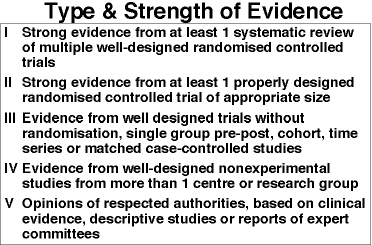
Where does
meta-analysis sit on the hierarchy of evidence?
[Meta-analysis] possesses certain flaws and limitations
that preclude its use as a broad-based methodologic approach for formulating
definitive therapeutic recommendations. -- Boden 1992.
Bibliography
Meta-Analysis: A Review of Pros and Cons. Abramson J. Public
Health Reviews 1990 18(1): 1-47.
Does Blinding of Readers Affect the Results of Meta-Analyses? Jesse
A Berlin, on behalf of University of Pennsylvania Meta-analysis Blinding
Study Group. Lancet 1997; 350: 185-186.
Evidence for Decreasing Quality of Semen During Past 50 Years.
Carlsen E, Giwercman A, Keiding N, Skakkebaek NE. Bmj 1992; 305(6854):
609-13.
The Existence of Publication Bias and Risk Factors for its
Occurrence. Dickersin, K. (1990). Jama 263(10): 1385-9.
Egger (1997)
Surgery or Embolisation for Varicocele in Subfertile Men (Cochrane
Review). Evers JL, Collins JA, Vandekerckhove P. Cochrane Database Syst
Rev 2001; 1: CD000479.
Should Unpublished Data Be Included in Meta-Analyses.
Cook DJ, Guyatt GH, Ryan E, Clifton J, Buckingham L, Willan A, WcIlroy W,
Oxman AD. Journal of the American Medical Association, 269: 2749-2753
(1993).
Geographic Variations in Sperm Counts: A Potential Cause of Bias in
Studies of Semen Quality. Fisch H; Goluboff ET. Fertil Steril (United
States), May 1996, 65(5) p1044-6.
Meta-analysis in Social Research. Glass GV, McGaw B, Smith
ML. pp.18-20. Newbury Park CA: Sage (1981).
Comparison of Intrauterine and Intracervical Insemination with Frozen
Donor Sperm: A Meta-Analysis. Goldberg JM, Mascha E, Falcone T, Attaran
M. Fertil Steril 1999 Nov; 72(5): 792-5.
Reference Bias in Reports of Drug Trials. Gotzsche PC.
Bmj 1992 295(6599): 654-6.
Combining Results from Independent Investigations:
Meta-Analysis in Clinical Research. Halvorsen KT, Burdick E, Colditz GA,
Frazier HS, Mosteller F. pp. 413-426, in Medical Uses of Statistics: 2nd
Edition, Bailar JC and Mosteller F (editors), Boston MA: NEJM Books
(1992).
Systematic Reviews in Health Care: Assessing the Quality of
Controlled Clinical Trials. Peter Jüni, Douglas G Altman, and
Matthias Egger. BMJ 2001; 323: 42-46.
[Full text]
A Quality Assessment of Randomized Control Trials of Primary Treatment
for Breast Cancer. Liberati A, Himel HN, Chalmers TC. J Clin Oncol 1986;
4: 942-951.
Interventions for Promoting Smoking Cessation During Pregnancy (Cochrane
Review). Lumley J, Oliver S, Waters E. In: The Cochrane Library,
4, 2001. Oxford: Update Software.
www.update-software.com/abstracts/ab001055.htm
Review of the Usefulness of Contacting Other Experts
When Conducting A Literature Search for Systematic Reviews
R J McManus, S Wilson, B C Delaney, D A Fitzmaurice, C J Hyde, R S Tobias, S
Jowett, and F D R Hobbs
BMJ 1998; 317: 1562-1563.
[Full text]
Sperm Function Assays and Their Predictive Value for Fertilization
Outcome in IVF Therapy: A Meta-Analysis. Oehninger S, Franken DR, Sayed
E, Barroso G, Kolm P. Hum Reprod Update 2000 Mar-Apr; 6(2): 160-8.
Have Sperm Counts Been Reduced 50 Percent in 50 Years? A Statistical
Model Revisited. Olsen GW; Bodner KM; Ramlow JM; Ross CE; Lipshultz LI .
Fertil Steril (United States), Apr 1995, 63(4) p887-93
Frequency of Citation and Outcome of Cholesterol Lowering Trials.
Ravnskov, U. BMJ 1992 305(6855): 717.
Meta-Analyses of Randomized Control Trials: An Update of the Quality and
Methodology. Sacks HS, Berrier J, Reitman D, PAgano D, Chalmers TC. pp.
427-442, in Medical Uses of Statistics: 2nd Edition, Bailar JC and
Mosteller F (editors), Boston MA: NEJM Books (1992).
Schulz et al 1995 JAMA
Publication Bias: Evidence of Delayed Publication in a
Cohort Study of Clinical Research Projects
Jerome M Stern and R John Simes
BMJ 1997; 315: 640-645.
[Abstract]
[Full text]
Systematic Reviews in Health Care: Investigating and
Dealing with Publication and Other Biases in Meta-Analysis
Jonathan A C Sterne, Matthias Egger, and George Davey Smith
BMJ 2001; 323: 101-105.
[Full text]
Meta-Analysis of Observational Studies in Epidemiology: A Proposal for
Reporting. Donna F. Stroup, PhD, MSc; Jesse A. Berlin, ScD; Sally C.
Morton, PhD; Ingram Olkin, PhD; G. David Williamson, PhD; Drummond Rennie,
MD; David Moher, MSc; Betsy J. Becker, PhD; Theresa Ann Sipe, PhD; Stephen B.
Thacker, MD, MSc; for the Meta-analysis Of Observational Studies in
Epidemiology (MOOSE) Group April 19, 2000. JAMA. 2000;283:2008-2012. Also
available at
www.consort-statement.org/MOOSE.pdf
Impact of Covert Duplicate Publication on
Meta-Analysis: A Case Sudy. Martin R Tramèr, D John M Reynolds, R
Andrew Moore, and Henry J McQuay. BMJ 1997; 315: 635-640.
[Abstract]
[Full text]
Cigarette Smoking and Sperm Density: A Meta-Analysis. Vine MF,
Margolin BH, Morrison HI, Hulka BS. Fertil Steril 1994 Jan; 61(1): 35-43.
Visibility of Research: FUTON Bias. Wentz R. Lancet
2002 (October 19): 360 (9341); 1256.
Additional
Resources and Materials
The Cochrane Library.
www.update-software.com/cochrane/cochrane-frame.html
"The Cochrane Library is an electronic publication designed to supply high
quality evidence to inform people providing and receiving care, and those
responsible for research, teaching, funding and administration at all
levels."
Meta-Analysis in Clinical Trials Reporting: Has a Tool
Become a Weapon? [Editorial]. Boden, W. E. (1992). Am J Cardiol 69(6):
681-6.
A New System for Grading Recommendations in Evidence
-Based Guidelines
Robin Harbour and Juliet Miller
BMJ 2001; 323: 334-336.
[Full text]
Rating the Quality of Evidence for Clinical Practice Guidelines.
Hadorn DC, Baker D, Hodges JS, Hicks N. J Clin Epidemiol 1996
Jul;49(7):749-54.
This article describes the system for rating the quality of medical
evidence developed and used during creation of the Agency for Health Care
Policy and Research-sponsored heart failure guideline. Previous approaches to
rating evidence were not designed for use in the setting of clinical practice
guidelines. The present system is based on the tenet that flaws in research
design are serious to the extent they threaten the validity of the results of
studies. A taxonomy of major and minor flaws based on that tenet was
developed for randomized controlled trials and for cohort and medical
registry studies. The use of the system is described in the context of two
difficult clinical issues considered by the Panel: the role of coronary
artery revascularization and the use of metoprolol.
PMID: 8691224 [PubMed - indexed for MEDLINE]
"Is Meta-Analysis a Valid Approach to the Evaluation of Small Effects in
Observational Studies?" Shapiro S. Journal of Clinical Epidemiology.
50(3): 223-229 (1997).
Assessment Criteria
www.jr2.ox.ac.uk/bandolier/band6/b6-5.html
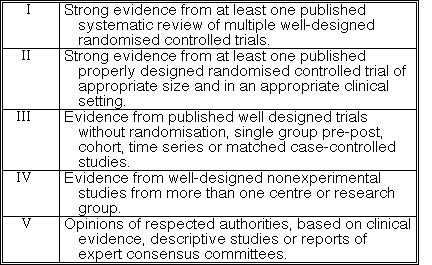
Evidence-Based Everything
www.jr2.ox.ac.uk/bandolier/band12/b12-1.html
Ionnidis et al 1998. [comparing meta-analyses to large trials]
 This work is licensed under a Creative Commons Attribution 3.0 United States License. It was written by Steve Simon on (unknown date), edited by Steve
Simon, and was last modified on
2010-04-01. Send feedback to ssimon at cmh dot edu or click on the email link at the top of the page.
Category: Statistical evidence
This work is licensed under a Creative Commons Attribution 3.0 United States License. It was written by Steve Simon on (unknown date), edited by Steve
Simon, and was last modified on
2010-04-01. Send feedback to ssimon at cmh dot edu or click on the email link at the top of the page.
Category: Statistical evidence